
High-Pressure vs Low-Pressure Aluminum Die Casting: Differences & Application Scenarios
 Jun 22, 2026|
 Aluminum die casting is a core lightweight manufacturing process widely used in new energy vehicles, communication equipment, industrial machinery, and consumer electronics. High-pressure die casting (HPDC) and low-pressure die casting (LPDC) are the two mainstream aluminum forming processes in the precision casting industry. Many design engineers and overseas purchasing clients struggle to distinguish their advantages and applicable conditions, which often leads to improper process selection, higher costs, or unqualified product performance. This article compares the working principles, structural performance, production costs, and industry application scenarios of HPDC and LPDC, providing professional reference for custom aluminum die casting project selection.
1. Core Process & Working Principle Differences
The fundamental difference between high-pressure and low-pressure aluminum die casting lies in filling pressure, injection speed, and molten metal flow state, which directly determines the casting's internal quality, dimensional accuracy, production efficiency, and applicable working conditions.
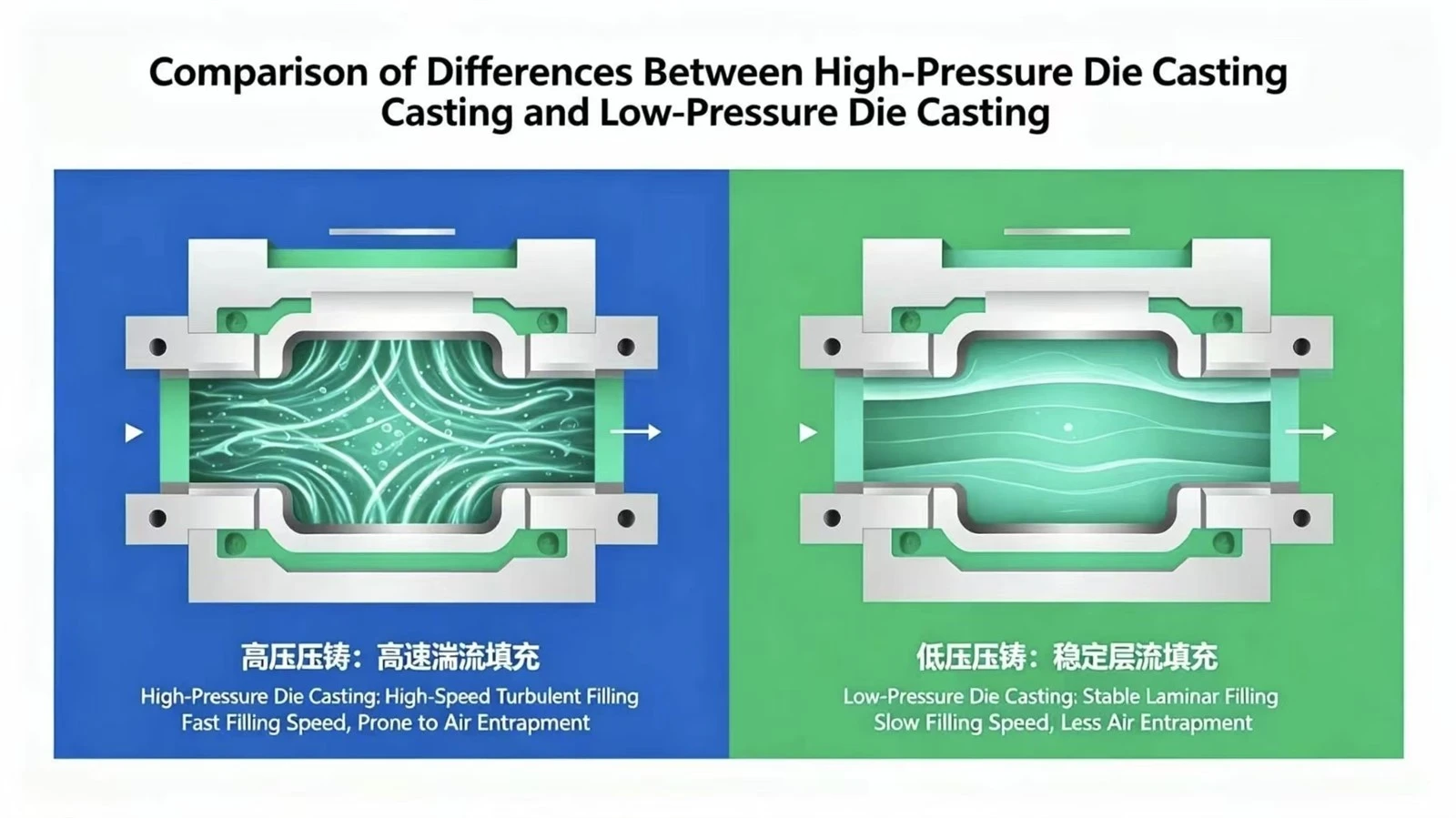
High-pressure die casting adopts ultra-high pressure of 40MPa to 150MPa and high-speed turbulent injection. Molten aluminum fills the entire mold cavity instantly, realizing rapid prototyping. This process delivers high dimensional accuracy and excellent surface finish, making it ideal for complex, thin-walled aluminum parts. Nevertheless, the violent turbulent flow will inevitably trap air inside the cavity, forming tiny internal pores. This inherent feature makes HPDC castings unable to support high airtightness and high load-bearing working conditions.
Low-pressure die casting uses stable low pressure of 0.1MPa to 0.7MPa to push molten aluminum upward through the feeding pipeline in a smooth laminar flow. The slow and steady filling process greatly reduces air entrapment. Equipped with independent shrinkage compensation systems, LPDC effectively eliminates common defects such as pores, cold shuts, and looseness. The finished aluminum castings feature dense internal structure and extremely stable quality.
2. Key Performance & Production Feature Comparison
In terms of mechanical performance, LPDC castings have obvious advantages. Their dense internal structure provides superior air tightness, pressure resistance, and weldability. Most importantly, low-pressure die-cast aluminum parts can undergo T6 heat treatment to greatly improve tensile strength and overall toughness. In contrast, HPDC castings have scattered internal pores, cannot be welded or conventionally heat-treated, and are not suitable for structural load-bearing and pressure-resistant components.
In terms of production efficiency and cost control, HPDC dominates mass production scenarios. Its single molding cycle only takes 20 to 60 seconds, supporting millions of annual output. Though HPDC molds and equipment require higher initial investment, the unit production cost is extremely low for large-batch orders. LPDC has a longer production cycle and lower hourly output, but it features lower mold opening and equipment costs, offering higher cost performance for small and medium-batch customized aluminum castings.
In structural adaptability, HPDC is perfectly tailored for thin-walled, intricate parts with complex grooves, special-shaped holes and curved surfaces, maintaining high precision and flawless surface effects. LPDC is more suitable for medium and large-sized aluminum parts with uniform wall thickness and regular structures, prioritizing overall structural stability and safety over complex shapes.
3. Precise Application Scenarios
High-Pressure Die Casting Applicable Scenarios: HPDC is the optimal choice for high-volume, cost-sensitive precision thin-walled components. Typical products include new energy vehicle auxiliary shells, communication equipment housings, electric tool accessories, and smart home hardware. It fully meets market demands for complex shapes, high surface quality, and large-scale standardized mass production.
Low-Pressure Die Casting Applicable Scenarios: LPDC is widely applied in high-strength, airtight safety-critical structural parts. Typical applications involve new energy vehicle motor housings, battery support brackets, automotive wheel hubs, suspension components, and hydraulic sealing castings. These key functional parts require high compactness, weldability and pressure resistance, which cannot be realized by standard high-pressure die casting processes.
4. How to Choose the Right Process?
To conclude, the selection of HPDC and LPDC depends on three core factors: part structure, performance requirements, and production volume. For complex thin-walled parts with large batch demand and no heat treatment or welding needs, high-pressure die casting maximizes production efficiency and reduces unit cost. For safety-related load-bearing, sealing structural parts requiring heat treatment and welding, low-pressure die casting is the most reliable solution to ensure long-term product stability and service life.